1885-ish - Compiled List of A. I. Root's Honey Plants

Read or download at Hathitrust!
This is a compilation of plants and comments from Root's catalogs that I am using as a guide to creating honey plant postings.   I'm still adding to it and correcting OCR typos.
I figured you might like to skim it.  
Occasionally I added the year a plant was in the catalog, but I forgot just as often. 
There is an index to the honey plant pages  done so far up above. 


"Mignonnette, catnip, motherwort, borage, melilot, and some others, I have tested, but am still doubtful in regard to them.  ..." A. I. Root


Bee-balm, or Melissa (1888) 
During the year of 1887 this plant called forth considerable attention, not only for the amount of honey it produces, but for the enormous numbers of blossoms found on a single stalk.  The introducer claims, in fact, that the large number of thirty thousand seeds have been counted on one stalk.  It is also so prolific in seed that the introducer claims to have received a bushel of seed from 2100 plants.  We can supply the seed.    
Per packet 5 cts.; per ounce, 15 cts.; per pound, $2.00.  For further description, see Gleanings for November, 1887
Borage. (1887 and 1888)

A strong, hardy, rapidly growing plant, bearing a profusion of blue flowers. It may be sown any time, but will, perhaps, succeed best, at about corn planting time. As it grows tall, and branches out considerably, it should have plenty of room. I know that bees are very busy on it, all the day long, from July until Nov., but I do not know how much honey an acre of it would furnish. 
It is easily tried, because it grows so readily, and if sowed on the ground after early potatoes are dug, you will get a nice crop of fall bloom. Sow broad cast, or in hills like corn.

In 1888 only: Borage is also used as a salad or cooked like a spinach. 
Price 10c. per oz., or 75c per pound.
If wanted by mail, add 18c. per lb. for bag and postage.

2016 - E. Craib, Connecticut - I experimented with a 10' x 10' plot of borage last year thinking it was Mother Nature's gift to the bee only to find they much preferred anise hyssop.  It could very well be that the borage did not like my garden's siting or soil.  You might get the opposite bee preferences. 

I looked up how to propagate the anise hyssop and was happy to see cuttings get plants going quickly and easily. If you visit me in a few years the paths around my house should be a symphony in purple anise hyssop!  (It also makes tons of seeds which made me think being a Johnny Appleseed sort of person might be fun.)  


Catnip. (1887 and 1888)   This has been very much talked about, and we have record of some experiments with an acre or more, but if I am correct, no one has ever yet seen a barrel of catnip honey. Still, someone may raise catnip honey by the barrel, and make money at it. If you wish to try, we can furnish you good seed, that we have tested ourselves, for 10c per oz., or $1.00 per lb.; 18c per lb. extra, if wanted by mail. Sow in the fall.
Dandelions.  (1887 and 1888)   I presume every body can get dandelion seeds and roots without buying them, but for all that, I have much faith in an acre of cultivated dandelions. Vilmorin's improved, is superior for "greens," and by the way our bees take to our "patch" of it, I think it must be superior for honey.
Price of seed, 5c per package, or 35 c. per oz.
Honey Pea.(1887 and 1888)This is the stock pea of the South and often yields much honey. It is also used for food. Price, $1.75 per bushel; $1.00 per half-bushel; 60c per peck, packages included: per lb.. lOe: by mail, 18c extra.bushel weighs about 30 lbs.

HORSEMINT, the celebrated honey-plant of Texas.Per oz. 20c; per lb., S2.00: postage. 18c per lb. extra.

Coerulea, bee clover. This latter blossoms in about six weeks after sowing, and bears a small blue flower.Price of seed, 10c per oz., or 7.5c per lb.; if wanted by mail, add 18c for bag and postage.

Lippia Nodiflora.For description see Dec. '79 Gleanings. Per oz., $1.00. Per pkt., .5c. Give hot-bed treatment.


Mignonnette. This is a great favorite with the bees, and also with those who are raising plants for their bees; but, although we have sold considerable of the seed for bee pasturage, I am not sure that any one has ever made it pay in dollars and cents, for he honey alone. It will pay, without any doubt, to raise the seed, especially if "the price keeps up anywhere near what it is now; but for honey alone— who will demonstrate its value beyond doubt?    The tall varieties seem best suited to the bees, but are not as fragrant. It should be sown in the spring, and as the seed is small, it should have fine clean soil, and be covered lightly. This plant seems to have a rare capacity for standing frost, and bees may often be seen busy upon it clear into October.The seed is 20c per oz., or $2.00 per lb. If wanted by mail, add 18c for postage.

Motherwort. This is a near relative of the catnip and is probably equally valuable as a honey plant. Prices of the seed, same as for catnip. Sow any time.

Mustard.The honey from this is said to be very light, equal to any in flavor, and to command the highest price in the market. We can furnish the common, (either white or black) for 10c per oz., or 26 c per lb. Add 18c per lb., if to be sent by mail.

Raspberry. A pretty good honey plant, too well known to need description. The Red Raspberries are thought to yield most honey, and of these the Gregg and Cuthbert varieties are said to be best.Price of plants, per ten, 60c: per hundred,$3.00. If wanted by mail, 3c each extra.

Rocky Mountain Bee Plant (Cleome integrifolia).Is closely connected with the noted Spider Plant (C. pungens) these two being the only species of the Cleome. With us, it is much inferior to the Spider Plant as a honey producer. We have reports from some localities of its yielding large quantities of honey, hence, quite a demand for the seed is the result. Price per lb., $1.25. postage 18c. extra. Per ounce, 15c.

Sage, White (Salvia argentea).Is called the honey plant of California, and belongs to the Labiatae or Mint family, the same as Rosemary. Balm. Hoarhound, &c. Price per ounce, 35c. per lb.. ?4.iXi.

Sweet Clover (Melliotus alba, or Meliot).— This has some valuable traits, as standing frost and drouth, but many times and seasons, the bees will hardly notice it at all.   The statement has been made that an acre can support 30 colonies of bees, and afford from 500 to 1000 lbs. of honey.  Such statements, although they may be honestly given, I think should be received with due allowance; about four pounds of seed are needed for an acre; sow like Alsike.  It will grow on almost any barren hillside, but it is a bad weed to exterminate; if, however, it is mown down to prevent seeding, the roots will soon die out. Sow in spring or fall.    We have it on our honey-farm, but it is rather behind the Simpson honey-plant in this locality.
Common Sweet Clover, per lb., ?c: 10 lbs., $1.50;
100 lbs., $12.00; if wanted by mail, add 18c for bag and postage. This is sold with the hulls on; the Bokhara is hulled.
Bokhara clover, seed received from D.A. Jones:
10c per oz., or 3.5c per lb.: 10 lbs., $1.00; 100 lbs..
?25.0n. If by mail, add 18c per lb. 
Sage, White (1883, 1893) (Salvia argentea) is called the honey-plant of California. (Silver Sage)
Sunflower.— This plant is visited by the bees in great numbers in some seasons, while, in others, it is scarcely noticed; but, as the seeds usually pay all expenses of cultivation, i holds its place as a honey
plant. The mammoth Russian bears by far the largest blossoms, as well is the largest seeds. 
Price of seed 5c per oz. or 1.5c per ft>. : 10 lbs. or over, 12c; 100 lbs., 10c. if wanted by mail, add 18c for bag and postage.

Spider Plant.— This plant, under favorable circumstances, yields more honey than anything that ever before came under my observation. In Oct., 1879, each floweret yielded drops so large that a bee had to make two or more journeys to set it all, and I succeeded in dipping the honey from the plant with a spoon, until I half filled a bottle with it, for experiment. As it only yields this honey early in the morning, and late in the evening, it willgo nicely with the Simpson honey plant. I should think it quite probable that 5 acres of each of these plants would keep 100 colonies busy enough to be out of mischief during a dry fall, when bees are so apt to be robbing. For particulars concerning both plants, see AB C of Bee Culture.The Spider plant is an annual, and should be sown every year. It grows most quickly with hotbed treatment, but will blossom in August if sown in the open ground in May.Price of seed — per package, 1o c.;  per oz., 20 c.; per lb., $2.00. Postage 18c per lb. extra.


Seven-Top Turnip.  -- This plant, although not equal to the spider plant and Simpson honey plant, is entitled to a place next to them, because it bears its crop of honey in the spring, between fruit blossoms and clover. It should be sown in Aug. and Sept. It bears no root like the ordinary turnip, but only foliage that is used for greens. Price of seed. 10c per oz., or 50c. per lb. If wanted by mail, 18 c. per lb. extra.

Sorghum, Early amber. This is not strictly a honey-plant, but sugar can easily and cheaply be made from it, for feeding bees or other purposes.  About 6 lbs. (4 qts.) are wanted for an acre of ground.  Price best Southern-grown seed, peroz., 5 c.; per lb..15 c.  If wanted by mall, 18c per lb. extra: 10 lbs. or more, 10c per lb.

Any of the above seeds will be sent in .5c packages,
to those who would like just a few to try.


OTHER HONEY PLANTS.

The following are recommended as honey plants, but I have not thought them worthy of a more extended notice for cultivation. Some of them have been tried on our grounds but either yielded no honey at all, or very little, and I have thought best to put them in here until we could give them a more extended trial. We keep the seed for sale in 5c. packages; if larger quantities are wanted, we will
give prices on application.
 
Aster (1883)
Blackheart. (1883)  (Polyganum persicaria) A large variety of Smartweed belonging to the Buckwheat family. If I am correct this is also called Heartsease. (Now usually called Lady's Thumb :-)
Cacalia, or Tassel Flower (1883)  (Sonecio sonchifolia) from India. Cultivated as a summer annual.
Blue Flag (Iris or Flower de Luxe).—A perennial, about 2 feet in height, comprising but few wild species, and grows better when cultivated. 
Clovers, foreign.

  • Alfalfa, grown principally in the Pacific States. (This is virtually the same as Lucerne). Prices same as White Dutch clover. 

  • Italian, or Scarlet (Trifolium incarnatum) introduced from Italy and France. The flowers are most beautiful, much resembling a large luscious strawberry. Blossoms first year. 

  • Lucerne or French (Medicago sativa). best for sandy soils. 

  • Yellow Trefoil (Medicago lupulina), a weed or pasture plant, in dry or sandy fields.
Erysimum (False Wall Flower).— Belongs to the Cruciferae or Mustard family, and comprises but three species.
Esparcette or Sainfoin (Hedysarum onobrychis). Usually classed with the clovers, as it belongs to the same family (Leguminosae or Pulse) as the Clover, Pea, Locust, &c.  
Fuller's Teasel (Dipsacus  fullonum) —A variety of teasel, usually cultivated; is valuable for carding woolen cloth, as well as for honey.— See A B C. 
Golden Rod (Solidago).— Belongs to the Compositae Family, and comprises a large variety of fall blooming plants.  
Hoarhound or Madwort (Marubium vulgare). 
Only this one species is common to America; was introduced from Europe and belongs to the Labiatae or Mint family.  
Hyssop (Hyssopus) — Only one species (H. officinalis), and belongs to the Mint family; is cultivated, and was brought from the Old World.

Mollie Heath, the honey plant, a species of acacia, having a most beautiful ornamental foliage, and called a very valuable honey-plant. We have never
yet got it to blossom here, but the beauty of the plant pays for cultivation. 
Monarda  Punctata (Horse Mint).— Belongs to the same genus as wild Bergamot (Monarda or Balm); grows well only in sandy soil.
Portulaca — Best uii.xed: makes a beautiful plant for the flower garden, blooms for months, and attracts swarms of bees every morning.

Phacelia (Name derived from Greek word meaning cluster: it has no common name).— Flowers in spring or summer, and belongs to Hydrophyllaceae or Waterleaf family.

Pyrethrum. the plant that furnishes the Persian insect powder. Seed, per packet. 10c. 
Spanish Needles (Bidens bipinnata).— Grows in waste grounds from Connecticut to Illinois, and south, and belongs to that immense family, Compositae. 
Spring Vetches or Tares (Vicia sativa).— Seems to be a cross between the Pea and Clover, partaking of the peculiarities of each, and belongs to the same family, Leguminosae. Does not yield honey with us.
Verbena Hastata (Blue Verbena). Grows to a height of 3 or 4 feet, and thrives in almost any kind of soil, if not too dry or sandy. 
Whitewood, Tulip, or Poplar (Liriodendron tulipefera). {Usually called Tulip Tree now}— A tall and handsome tree, usually planted for ornament, and valuable for shade and timber, as well as for its honey producing blossoms.
 See Basswood Trees.

1872 - Confound Those Bees!

My bees just swarmed, so I feel for John Dull.  
Swarm humor does not change over the centuries!   I find that very comforting.


1890 - Vermont's Mr. Manum and His Apiaries

What a great photo!!

 Mr. Manum, of Bristol, Vt.

News article below from:  Democrat and Chronicle,  Rochester,  New York, Friday, February 7, 1890, Page 6
A. E. Manum of Bristrol, Vt. , followed with a paper on  "How to Run Several Out-Apiaries for Comb Honey in Connection with the Home Apiary for the Most Benefit." 
 Mr. Manum had located his out-apiaries about five to fifteen miles from his house, the latter being on the west side and at the base of a high mountain. His out-apiaries are on the north, west and south, something in the shape of a half-moon.  The apiaries are so situated that they all can be visited, save one every day. 
Mr. Manum found it advisable to allow bees to swarm once. He thought that while out-apiaries could not be run as economically as home apiaries, they could be operated economically.


1814 - The Formidable Miss Macdonnell - Beekeeper and Society Lady

Miss MacDonnell appears to be a formidable woman of many interests, including horticulture and beekeeping.  I first encountered her in the article on Mr. Love - the good man who loved both pinks and his bees.  She gave him a hive of bees, and the article added she won prizes for her large honey combs at competitions.  This article is a charming introduction to early 19th century Scotland.

The Late Miss Caroline H. E. MacDonnell
I have added illustrations below when I could find them.  Many are postcard images.  There were none but the two portraits above (which I played with) in the British Bee Journal & Bee-keepers Adviser.
__________________________


No. 32.—Miss Macdonell, Of Glengarry.


(Extracts from the autobiography of the last of the 'Chieftain's Daughters' bearing the name.)


'I was born at Glengarry on Loch Oich, the highest part of the Caledonian Canal, on September 27th, 1814, and quite close to the site of the old castle, which was blown up by Cumberland in 1746—a few yards from the garden in which the bees were kept. 


I am the fourth daughter of Colonel Ranaldson Macdonell, of Glengarry and Clan Ranald. My mother was a daughter of Sir William Forbes of Pitsligo, Bart., and before her marriage, at twenty-two, lived in Edinburgh. There were seven daughters of us and seven sons; six of the latter died under three years of age. 

Picture credit: National Gallery of Scotland
We were a bright and cheerful family, full of mental and bodily vigour among the mountains and glens of our Highland home. My mother was a very clever person in many ways, and wag quite bewildered at her new mode of life, having to send a horse and cart to Inverness (forty-two miles) for some coarse needles the housekeeper wanted: but many other useful articles came back in the cart. 

River Garry

My father's birthday, September 16th was always celebrated with Highland games. They generally took place in a field about two miles from the house. We children walked with our governess, the elder members drove—which sometimes seemed a very perilous undertaking, as they had to cross a wooden bridge over the river Garry, which used to shake violently.

The horses particularly disliked the sound it made; my mother was quite afraid, but my father was always determined that horses and servants should do their proper work, and her only relief was to patter her feet on the floor of the carriage, as he said screaming both frightened the horses and made the servants useless.

It was a great day for us children: tents were always pitched for shelter. The feats were splendid, and very different from what they are nowadays. 

I do not remember the weight of the stones or the hammers thrown, nor the weight or the length of the caber-tree; but the leaping was admirable over a pony's back, probably thirteen or fourteen hands high. 

Our piper used to tell us that he had performed the feat of leaning in and out of six herring-barrels placed close together in succession.  

After the games there was always dancing to the pipes in the evening, and the foresters and deer-stalkers did dance well. No one could appear at those games and dance, but in the Highland dress, kilts and plaids, looking beautiful.


When any entertainment took place on a Saturday my mother was most careful to put the clocks forward twenty minutes, so that the house should be cleared before twelve o'clock. 
A "deoch-an-dorius"—a parting glass of whisky —was given to each man in passing out.
(Note: Modern spelling is deoch-an-doris.)


 About 1824 the Caledonian Canal was opened, and after this our first boat-load of coals arrived at Glengarry; formerly nothing was burned but peat. My father had a large and handsome barge built, and that same year I remember seeing the first two hives of bees arrive.  My father was very anxious for everything that would ameliorate the condition of his people; he had an intense liking for all national things, which I inherited.


We three schoolroom girls were as wild as young goats on the arrival of a new governess from Edinburgh. Before she got to the front door a large deer-hound seized her muff and took it from her; her eldest pupil appeared at once and presented her with it, after scolding the dog in Gaelic. 

Without shops, the advent of a packman was hailed with delight, and justified our vanishing from the presence of the governess. The only other excusable occasion was a dogfight: at the first sound we were off and in the thick of the battle, to rescue a visitor's dog from the fangs of the deer-hounds; we had many of them, my father being very fond of deer-stalking. 

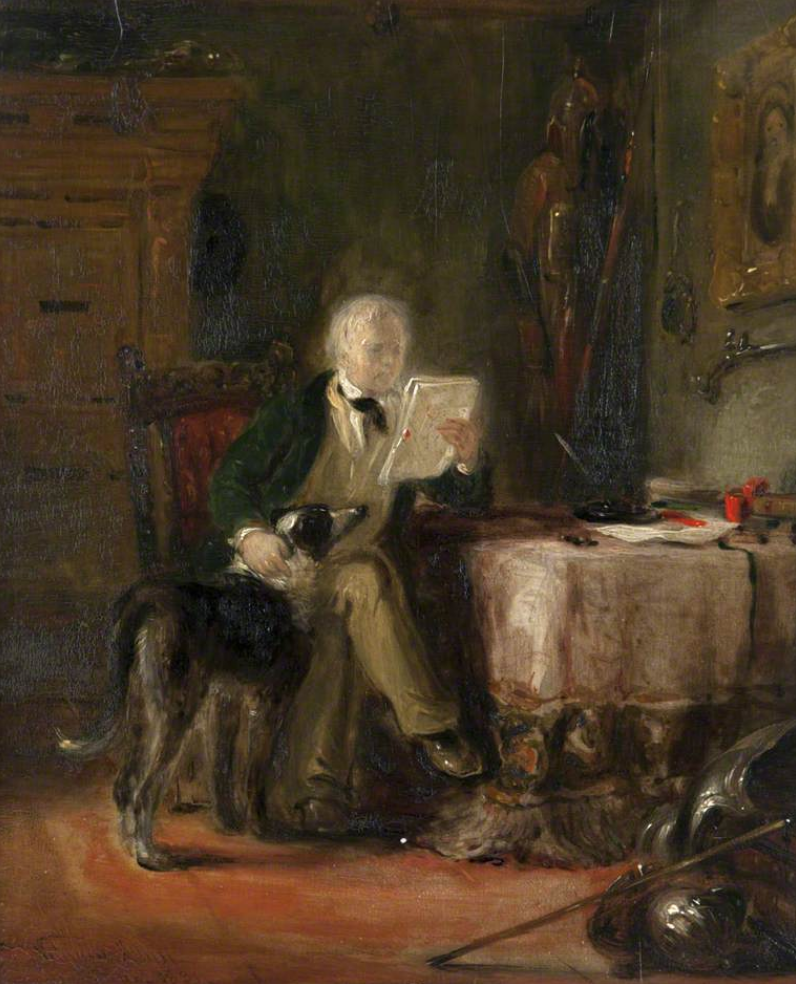
Sir Walter Scott with Maida


It was he who presented Sir Walter Scott with "Maida", his favourite stag-hound, named after the tattle in which my uncle, Lieut-Col. Sir James Macdonell fought.  It was this same uncle who held the gates of Hougoumont at Waterloo.  
This dog was Sir Walter's chief favourite, was often painted along with him, and died at Abbotsford in 1824 and was buried underneath the "leaping-on-stone", with this couplet inscribed:—
"Beneath the sculptured form which late you wore,
 Sleep soundly, Maida, at your master's door."


We were in the habit of going to Perth for the winter.  One season, in the end of November, my mother, fearing more snow, ordered twenty men with shovels to start early to clear the road, but more fell after we left.   Papa sent a message from the first carriage we were all to get out and walk. One of the maids fell into a wreath, and papa made a joke of her requiring two handsome fellows to pull her out.  The frost was very keen, and our wet clothes froze; the fringe at the foot of my brother's Glengarry in Waverley tartan trousers was hanging in icicles, and my second youngest sister was ready to cry with the intensity of the cold, but was told it would be worse for her then, as the tears would freeze on her cheeks.

My father started for Edinburgh with my two eldest sisters, a great storm arose, and the steamer was wrecked. On leaping on a rock he struck his head, and he died of brain fever that night (January 17th, 1828), and was buried on February 1st with all Highland honours. To the admirers of Scott it was well known my father was the prototype of "Fergus McIvor". His character was such as Sir Walter delighted to portray; and in the Procost, by Gault, there is an account of my father at the coronation of George IV.
Fergus McIvor is on the right...


Merchiston Castle


After our father's death we came to reside at Merchiston Castle, near Edinburgh.

We soon came to consider the confinement quite dreadful, and began to wonder how long it would take us to run some three hundred miles back to Glengarry again, so we measured how often round the battlements made a mile.


We started with as many bits of wood in our hands, leaving a piece each time we came to our starting-point. On these battlements we might sing our Gaelic songs as much and as loud as we liked. One day our governess was told by a friend that he had been quite startled when walking on the road by singing in the air, which no doubt emanated from the battlements.


Perhaps my first bee-memory was at Glengarry, when I saw a swarm proceed from our green-painted bee-house, and watched them taking up their quarters in the roof of the mansion-house, whence they were with some difficulty dislodged by the gardener. 


This is Cotton's book. Charles Cotton.
I remember seeing a large crock of Glengarry honey when we lived at Merchiston Castle in '28 or '29.   
We came to live in Bute in '41, and in '46 we bought a couple of hives near Mount Stuart, and used Cotton's book as our guide.   Our efforts in bee-culture at that time were not successful, after a long and varied experience, purchasing all sorts of hives and quite overloaded with bee-gear.

In 1878 we made the acquaintance of the gentleman who writes in your columns as "A Renfrewshire Bee-keeper," and he kindly invited my sister and me to pay him a visit, which we did, and he showed us his apiary, and explained everything to our entire satisfaction.

We saw his Scotch-made embossed wax machine, which he told us was stereotyped from the original German sheets long years before the American rollers were invented, or the words "Comb Foundation" coined. 
Stewarton Hive
His apiary consisted chiefly of storified colonies, cultivated with success in Scotland  centuries before the word "Tiering" was invented in America. All the combs in his hives were movable, in frames or bars, and in the shallow supers as well. His very beautiful watering device we admired much, as well as his original rotating Observatory hive, which had great attractions for us.

My sister was the first to set up a Stewarton colony, and I followed. They proved a great success, and we had the pleasure of exhibiting our beautiful supers at Rothesay Show.

The "Renfrewshire Bee-keeper " kindly gave us in 1880 the use of his trained boy, and he quite charmed us; so much so, we begged the loan of Peter again, and for that Saturday invited a few friends to a garden party at Lochna-Gaoidh to witness his doings.

The little fellow gave a few puffs of smoke from his brown-paper roll, doffed a cover, drew the slides, and explained it was necessary to give the bees time to supply themselves with food, then raised the frames, and handed them about, showing the queen and all the internal economy of the hive—and such an expert was he that he restored everything to its original condition without a sting to any one. Eleven years have sped past, and though Peter Kerr is now a full-fledged engineer, he comes to assist me still.
My Renfrewshire friend kindly ordered for me a similar Observatory to his own.  It was setup in the drawing-room at  Loch-na-Qaoidh, since removed to my present house in Rothesay. Nothing affords me greater pleasure on a holiday than having the teachers and children of my initiatory school up for a bee-lesson—our School Board teachers and children, too.  They are then shown how loyal the bees are to their queen, forming a body-guard around her, court etiquette practiced, retiring backwards before her. Each bee is prepared, if need be, to go forth and lay down its life "in defense of Queen and country".

There are no strikes in the beehive. They are too clannish for that; short shrift for the agitator there. They could not brook to see the honey drift past their own into other waxen kingdoms.

1891 - Mr. Love's Long Life With Bees


This article from the British Bee Journal & Bee-keepers Adviser celebrates the good man, John Love, as a beekeeper. I have been getting an article about him as a famous grower of pinks when I got lured away by bee. Pinks are coming!   I have added illustrations when I was curious to know about something (if I could find any).  I would have liked Mr. Love as a neighbor.


OUR PROMINENT BEE-KEEPERS.


No. 30—MR. JOHN LOVE.

We have much pleasure in giving this week the portrait and a biographical sketch of the veteran bee-keeper, Mr. John Love.  Born in the village of Kilbarchan, Renfrewshire, on 10th April, 1806, bred a hand-loom weaver, as were his father and grandfather, three Johns in line, he maybe said to have been a born beekeeper, as he remembers a saying of his father's -that in the old garden the hum of the bee had been heard without a break for sixty years. 


Of middle height, fair complexion, with high colour, the fringe of pretty, fair, silky hair below his wide-awake behind, this 'yellow-haired laddie' of eighty-five summers is frequently taken by the stranger as wearing on to seventy.
If the sentence above made you read it twice, be it known that "The wide-awake, a broad-brimmed felt hat with a lowish crown, was a countryman's hat". (I thank the source!  I remember acutely doing research in pre-computer days. I think the magic of the web will never dull for me.☺) 

Still remarkably nimble and fleet of foot, of a very amiable disposition, his laugh is as nappy and jubilant now as I believe it to have been when, a boy of nine, he remembers listening to accounts read from the papers of the glorious victory of Waterloo.   For many years an exemplary Presbyterian elder, growing deafness (his only infirmity) prevents him now from performing all the duties of the office.   So healthy has he been that only once during his
long life, for a fever, has he required medical advice.   He married, 12th August, 1833, Mary Climie, daughter of a weaver's agent in his own village, and has been blessed by a numerous offspring.

A few years after his marriage the subject of our sketch moved to Mount Pleasant, beautifully situated on rising ground above the village, and occupied jointly with his brother-in-law, the upper flat as their dwelling  house — workshops below, a good garden behind. 

The passer-by could not but be attracted by the bee-house, a neat model of a two-storied dwelling-house, complete to the sweep on the chimney.  The numerous odd hives of the two dwellings were cosily placed in sheltered nooks under the many crafted fruit-trees. The floral display of roses, herbaceous plants, &c. was very fine but in their season the bed of pinks was the great attraction. 

Mr. Love for many years was the acknowledged Scottish champion 'pink' grower. Upstairs his stuffed specimens of natural history reflected great credit on our friend's taste and neathandedness in another direction. 

It has been recorded in these pages long ago, when the Italian bee was newly imported, how a petition was couched in respectable verse from the Kilbarchan fraternity for leave to inspect the new bee: the writer of it was Mr. Robert Climie, Mr. Love's brother-in-law. 
Alas! that deputation has all passed away save Mr. Love.  

Curious how the poetic vein descends, coming out in the children and grandchildren of Mr. Love.  Robert Climie's end, some twenty years ago, was very affecting.  He was invited over to a neighbouring village to examine the bees of a married daughter of Mr. Love.  A non-smoker himself, he administered a whiff of the pipe, said to his niece he felt sick, and would never touch that vile pipe again, retiring to an inner room, where she in a little while found him kneeling by the sofa in prayer, in which posture his gentle spirit passed away.  The funeral was largely attended, service in the open air, a beautiful spring day, the woods of Glentyan across the strath, and the village nestling in the hollow, bees out in force—very touching to beekeepers present to see his little favourites hover over the pall and odd ones resting on it, as if taking a long farewell of the old master ere his remains were borne away.

Time brings its changes, the kindly old Laird dies, the estate is sold, and Mr. Love after an occupancy of thirty-eight years has to move his looms into the smoky atmosphere of the town of Paisley, where he and an unmarried daughter bravely struggle on, plying their shuttles side by side.  In the interim, first the partner of his joys and sorrows, then his youngest and fairest flower, droop and die.  Gladly he accepts an offer to take charge of a cottage and pony, grow and dispose of a large fruit-garden crop in the island of Bute.  Rarely do we find a man at seventy-six so cheerily abandon his life-work, and begin to earn his bread by his hobby.


In the autumn of that year, 1881, the writer sailed to Bute and made the acquaintance of that steep ascent, the serpentine road, resting to gaze on the beauty of the grand prospect: Rothesay Bay at our feet, Joward Castle on the opposite shore, the glassy smoothness of the far reaches of the Kyles of Bute in the rugged distance.


The hill-top is at last gained; there, bareheaded as usual, busy among his strawberries, stands our hero. The joy at meeting!  'Why, John, you look like an old eagle perched on this hill-top!'  The bees and honey prospects are discussed, and the tremendous crop on his gifted young Caledonian plum-trees presented by John; a branch promised and hamper followed. 


By return of post the hit-off thanks :—


"Through wind and rain your basket came
     In safety—it is here.
'Twas careful hands that packed it
    With its richly-laden store.
 
I never can repay you,    But I thank you o'er and o'er, For there are deeds of friendship    Words may not all impart,Their sterling worth, as deep they sink   Into our inmost heart. 
Then, once again I thank you    From here, my mountain home,And, one and all, I wish you joy   In the year that is to come.'
The Stewarton: The Hive for the
busy man


I gave him an introduction to my good friend Miss Macdonell, of Glengarry, and he assisted her with her bees, and that lady, in the kindest manner possible, presented him with a couple of swarms, and he was once more into stock, whose descendants he still carefully preserves.  

The above lady takes an enthusiastic interest in the bee and the silkworm.  


A handsome mahogany rotating observatory ornaments her drawing room, and the supers from her gigantic Stewartons overtopped everything at the Rothesay Exhibition. 


She also takes a warm interest in the cause of religion and education, in maintaining the purity of worship in the National Church;  is thoroughly practical, projected and supports an Initiatory School where poor boys are taught the ground-work of religion, besides the ability to sew on buttons or patches on their jackets.   


detail; source


At the School Board she has sat for nearly six years, the only lady, and heroically defends her position with as much determination as did her illustrious uncle the gates of Hougoumont at Waterloo.


Three verses are extracted from a letter or Mr. Love's on another occasion:—

'I will whisper my tale to the Yule-log   As I muse in its ruddy glow,As here again comes Christmas,   With its holly and mistletoe.
                                *****
'Tes! that is the tale I whisper,   As I muse in the firelight glow,As I sit, in the hush of the evening.
  And think on long ago; 
'On the happy home of my childhood,   On the friends I held so dear:One by one they have left us,
   They are no longer here.'
                                  *****   

After a five years' residence in Bute he came back to Kilbarchan, and the bees and pinks are safely flitted to his present garden.  After the labours of the week are over, it is a much 
anticipated pleasure on the Saturday half-holiday, skimming over the four miles that part our dwellings.  The newest ideas in bee-keeping are discussed, the last bed of pinks planted by himself seen to, and the latest-come herbaceous plant criticized; and if in autumn the fruit-crop is peculiarly interesting — those 'Bouquet trees, the waxy purity of the white 'celestial' apple flanked on either side, same tree, by branches of the scarlet or striped varieties successively.  

He often ejaculates,  "It bates a!"  
How comes such heavy crops? Your good grafting and the fertilizing powers of our little friends, the bees?  
 "Nae doot, nae doot!"

One fine Saturday afternoon autumn was a twelvemonth, we were favoured by a visit from 'Our Editor,' pointing out to him how  "history repeats itself", our old Japanese lion, worshipped for 3000 years, had been peopled that season by a colony of humble-bees as Samson's was, the subject of our sketch arrived  and the pleasure of that introduction he will never forget.